REFLECTIONS
Science for All: The Art of Communicating Science
By: Kyla Andrea Paragas, Intern, Probe Media Foundation, Inc.
Growing up, one of the things I had to unlearn about science was that it was not meant to be deliberately obscure, as if it were a grand maze in which only a handful of people had a map of it, so the rest would be left wandering and lost.
When I was a Medical Technology student, I would watch videos from various educators on YouTube who explained the challenging concepts in a simpler, more straightforward way. In one of my classes, Cytogenetics, my professor would often make analogies using the plots and characters of popular films so we would better understand and retain the information. I remember wishing he would be the professor for all my courses because he made studying chromosomes and cell processes fun and less complicated. Through narrative conventions, the intimidation around science is reduced, replaced by fascination and familiarity.

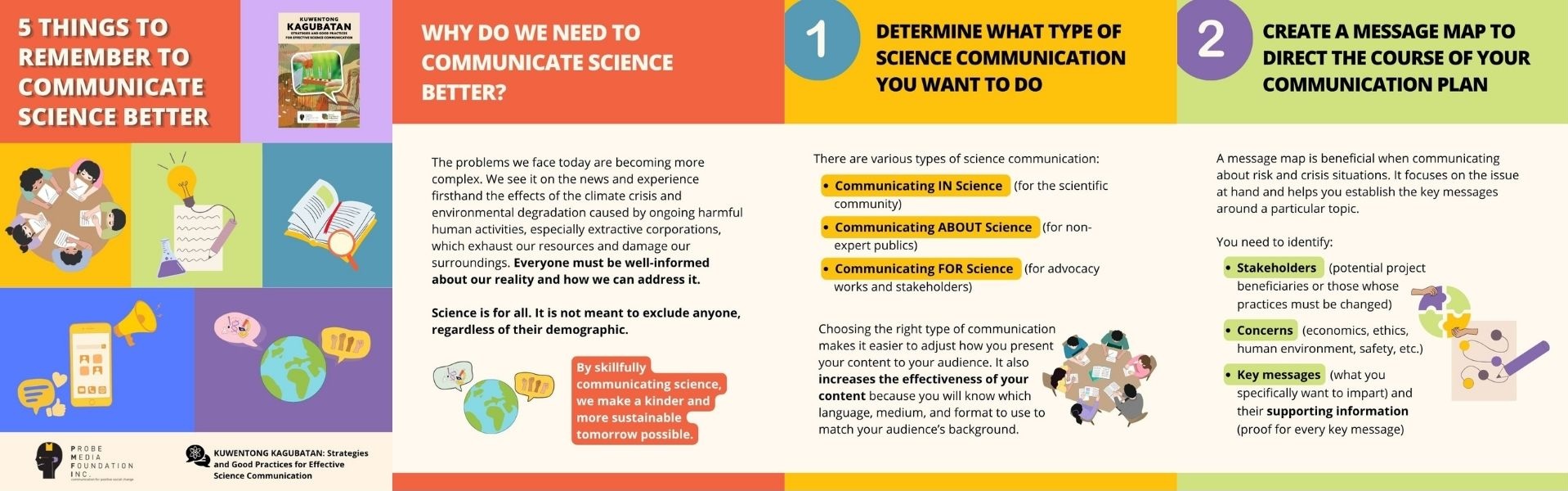
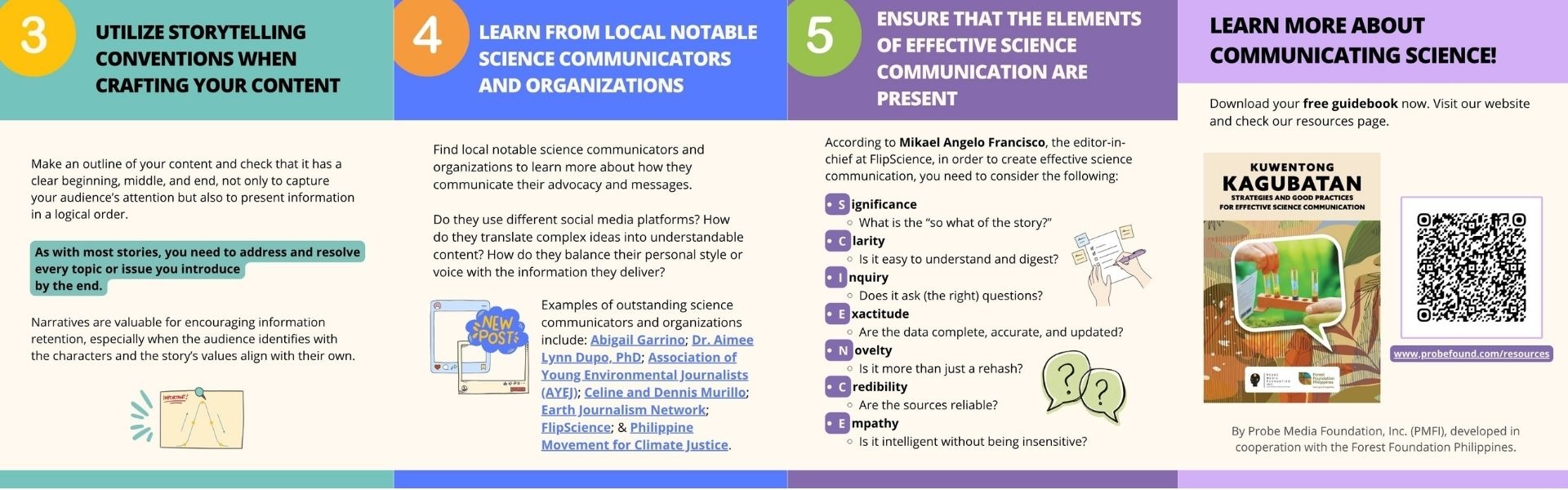
That’s why science and storytelling go hand in hand. Reading Kuwentong Kagubatan: Strategies and Good Practices for Effective Science Communication reminds us, especially for scientists, researchers, and other communicators, to be mindful of the way we communicate our ideas. By conveying a complex idea through a story, the perspective on the topic shifts: from potentially hard to understand to positively comprehensible. Storytelling teaches us the importance of having clear language and structure.
On the one hand, when it comes to language, a writer who utilizes extremely ornate language compromises the quality of their story and prevents the reader from identifying the intended message. Even if a scientist writes a paper essential to their audience's issues, if their output is packed with heavy jargon, this often deters readers or leads to misinterpretation. Clear writing ensures the audience accurately understands the message and avoids harmful consequences.
On the other hand, when it comes to structure, a popular approach is the linear narrative, with a distinct beginning, middle, and end. The reader can easily track the progression of events and how the conflicts will be addressed and eventually resolved. If a researcher presents their topic in a disorganized manner, they risk losing the audience’s attention and interest.
Ultimately, it does not matter how innovative or eye-opening your findings are if that knowledge will remain within a privileged bubble, benefiting only a select population.
Science is for all. It is not meant to exclude anyone, regardless of their demographic. The problems we face are becoming more complex, and it is only a matter of time before the human-induced disaster we are watching on the screen becomes a tragedy right outside our home. More than ever, as news of worldwide environmental degradation due to the continuous harmful activities by corporations and the elite, which exhaust our resources and damage our surroundings, it is vital that everyone is well-informed about our reality and the ways we can address it.
After all, at the core of science lies our love and care for the world we live in. People invent because they want to make lives better for the current and future generations. We study what is around us—from the iridescent stars in space down to the creatures burrowed into the seabed—because we want to find out just how intricately woven our connection to one another is, and realize that our differences are the threads that bind us together. By skillfully communicating science, we make a kinder and more sustainable tomorrow possible.
To learn more about the strategies to communicate science effectively, download a free copy of the e-book: Kuwentong Kagubatan: Strategies and Good Practices for Effective Science Communication.