A Letter a Young Storyteller
By: Kyla Andrea Paragas, PMFI Intern
Dear Fellow Young Storyteller,
There is no corner in the world where we cannot find a story. Everything has a story. Everyone has a story. But most do not know how to tell it.
They say that through words, we preserve the temporary—the laughter from our friend when they hear a joke, the kindness from a stranger on our way home, the last conversation with our loved one. In the days of our unbound childhood, as we try to know the universe and unravel as many of its mysteries as we can, we make sense of them by weaving them into tales that we share with others, hoping to know that we are not alone in our discovery. Stories are threads that connect the writer and the reader not just to each other, but also to the world—the past, present, and future.
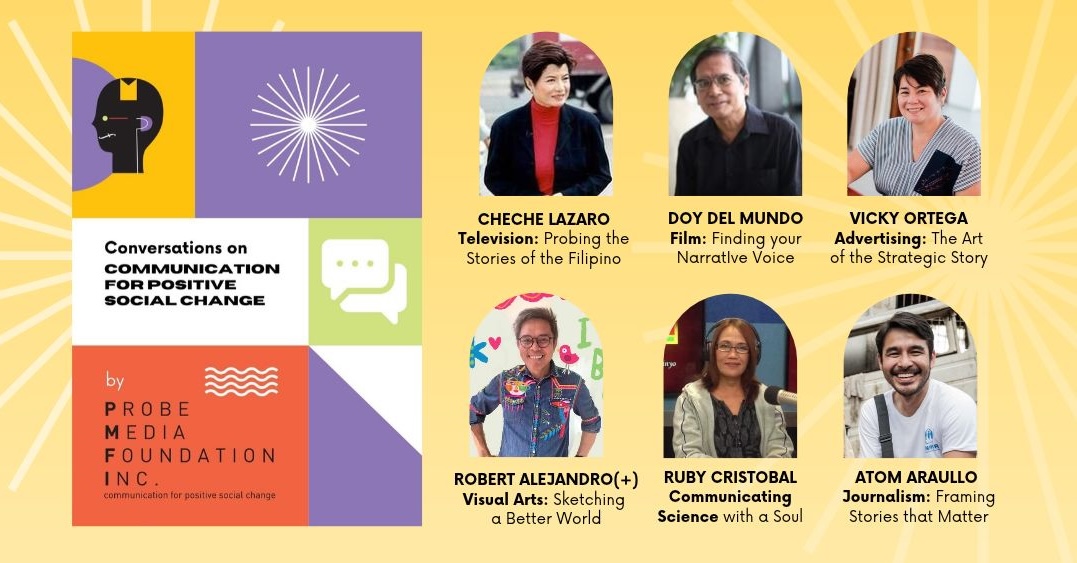
We have to define what constitutes a good story first. According to Broadcast Journalist Cheche Lazaro, good stories are the ones that “uplift the spirit, stories that make you feel good about the world. Stories that make you appreciate what you have, which you sometimes don’t, because nobody calls attention to it. What we’re always focused on is what’s wrong. We’re not focused on what’s right. But when people shine the light on what’s right, those are good stories. Those are good news stories. We need that because in a world that is sometimes dominated by bad news, there is room for good news.” If we only pay attention to what is wrong, it is easier to burn out and, worse, lose sight of the progress around us, even if it may seem small.
Advertising and Brand Storyteller Vicky Ortega also adds that good stories inspire people and make them “want to do something positive. It should open people’s minds, and it should open people’s hearts. I think there are some stories that open people’s minds, but if they don’t open people’s hearts, then they won’t make people do something positive. It’ll only make them understand it. What pushes us to do it is if we feel it: visceral. It should hit the gut.” A story should be something that awakens us and ignites parts of ourselves that we have not even known to exist.
Now that we know what good stories are, it is imperative that we also learn what makes a good storyteller. After all, a good storyteller is nurtured by their experiences and their skills, which they take their time to develop. Curiosity, for Cheche Lazaro and Vicky Ortega, is a requirement that a good storyteller must have. If we are curious, it means that we want to learn about things we do not know and spark wonder. Vicky Ortega argues that if you are curious, you follow your “willingness to learn” and are not afraid to explore something new or different.
For Screenplay Writer and Director Doy Del Mundo, it is crucial that “you have to catch the interest and attention of your audience, of the viewers, and you use the elements that are available to you.” But that does not necessarily mean you have to use expensive and complex tools. This is where your creativity comes in. How will you be able to deliver a good story in your chosen medium in a way that hooks your audience? Among the available stories out there, what makes yours stand out?
I have always known that storytellers need to be curious and creative, but Science Communicator Dr. Ruby Cristobal, who helped produce Sineskwela, and Artist and Designer Robert Alejandro, who was the co-founder of Ang Ilustrador ng Kabataan (Ang INK), have shared strategies on how we can further enhance our storytelling. Their strategy? We have to make our stories clear. If we have a clear purpose, a clear message, and a clear understanding of your audience, then you will know how to structure your story. If we say we are making it for everyone, we risk not getting anyone’s attention, since the story might be underdeveloped or clunky because we are trying to accommodate everyone’s interests.
For Vicky Ortega, once we are editing our story, we must also ask ourselves: “What insight am I using to make this story relevant to the people I’m speaking to?” We cannot just tell a story without evaluating whether it serves a purpose for our audience; otherwise, we are just wasting their time.
However, the journey of storytelling is not always smooth and sunny. There are obstacles that will suddenly appear out of nowhere, preventing us from continuing. Other times, the signs—or lack thereof—will be confusing, driving us to worry if it is still worth it. Today, technology is one of the challenges that storytellers face. Learning Experience Designer Paola Ceriola tells us that amid the fight against troll farms, algorithms, and machineries, “there are opportunities for us to learn from whenever these things happen. How did it work, or didn’t work?”
Across social media platforms, the fight against disinformation carries on. For Dr. Ruby Cristobal, to counteract fake news, we must “produce more positive, accurate, fact-based, evidence-based, science-based stories.” It is difficult to regulate the influx of fake news now that the threshold for uploading content is so low—just a click of the mouse or a press of the keyboard. For Environmental Journalist Val Vestil, it is essential that “we just surround ourselves with the right kind of community, who not only support the work that we do but also criticize it productively, I think all media practitioners can learn from it. I still believe in the power of mentorship. And I believe that young people need to find the right mentors.”
Above all, Robert Alejandro will remind us that while it is true we will encounter different challenges, we have the ability and creativity to figure them out and get past them. That’s why we should believe in the importance of our story. If we think that our work will change something about the world, then “the challenges become minuscule to the job that needs to be done.”
A good storyteller, with their good storytelling, creates effective and engaging stories, where words become a collective force that shows us a new way of thinking and transforms our nation, leading to positive social change. But with all the bad stories around us, it is easy to get lost in the cacophony of lies and disinformation. Therefore, Doy Del Mundo asks us not to simply “believe what the crowds believe. Stand on your own, and think. A wrong idea believed by 31 million people remains a wrong idea.”
Apart from that, Broadcast Journalist Atom Araullo encourages us to “have courage to find your voice, to be confident in what you want to say, and not to be afraid to challenge the positions of the adults.” He also says it is equally important “to have the humility to change your mind when the facts that are presented show you that you are wrong.” It is not a personal attack against us if someone corrects the information we provide. Just remember that we want the same thing: the truth.
This letter will end, but the conversations on what it means to be a good storyteller will prevail from one generation to the next. New voices will be heard. New stories will be read and watched. However, the pillars of the foundation in storytelling—the insights gifted by celebrated storytellers—will remain, guiding and supporting both the old and young storytellers.
There is no corner in the world where we cannot find a story. Everything has a story. Everyone has a story. But we now know how to tell it.
So we start.
All information and insights come from the e-book, Conversations on Communication for Positive Social Change by Probe Media Foundation, Inc. (PMFI). The book features dialogues and discussions with PMFI’s board and members on how the different ways of communication and storytelling continuously build our nation. The insights gathered from the distinct perspectives shared by renowned communication practitioners, ranging from their personal journeys, struggles, triumphs, and wisdom, empower readers to write their own stories and seek ways to bring about positive social change that ripples through time.
Get your free copy now. Visit https://www.probefound.com/resources/convos-comms4change